What if the fastest GPU for running a local large language model on your DIY rig wasn’t a flashy new GeForce but an eight‑year‑old server card sold on eBay for the price of a midrange pizza night?
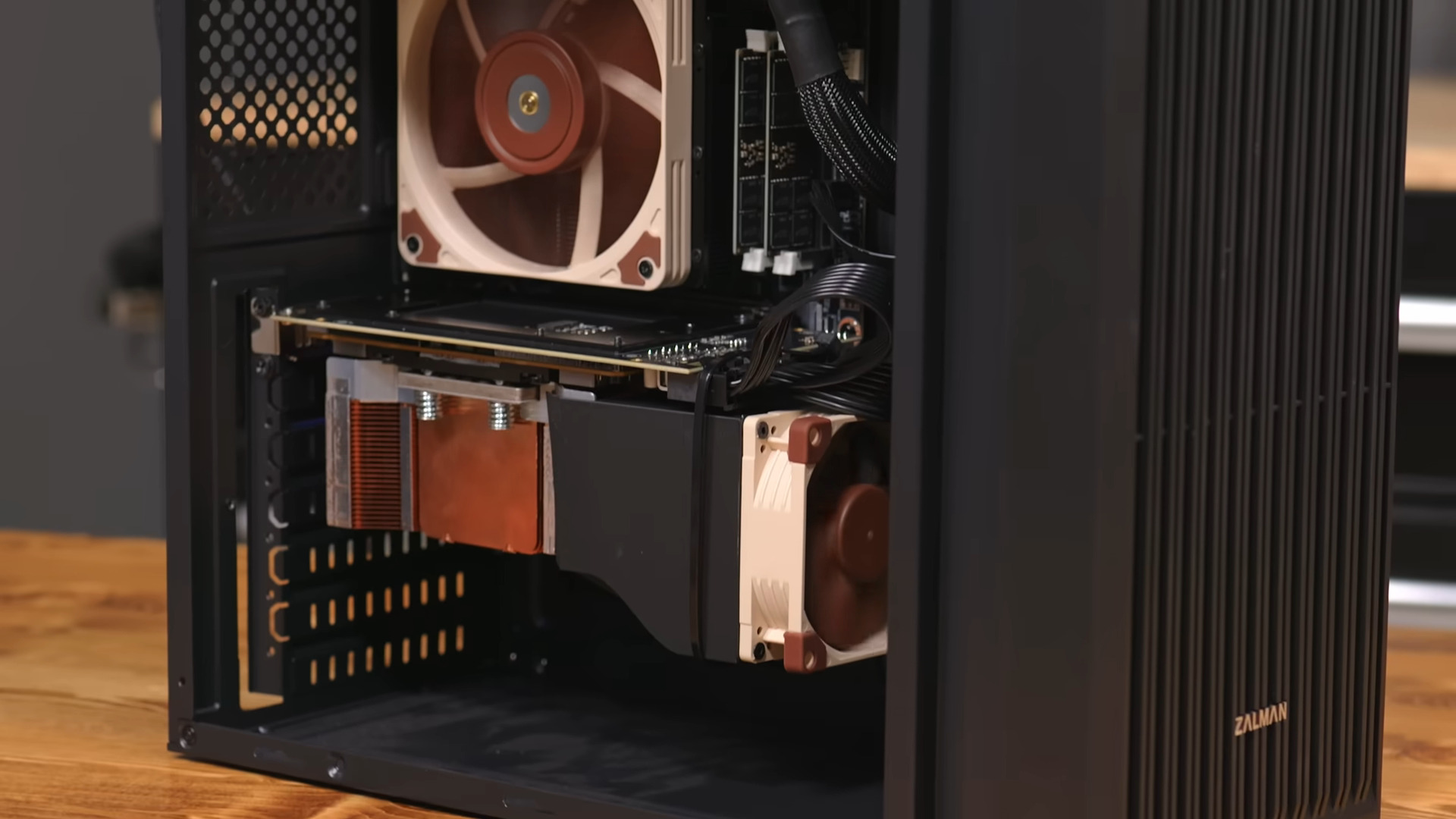
That’s the hook behind a recent hardware teardown-and-benchmarking run that took an SXM2 NVIDIA Tesla V100 — a Volta‑generation data‑center GPU — and shoved it into a consumer motherboard via an SXM→PCIe adapter, a custom PCB, and a 3D‑printed cooling duct. The out‑of-pocket math: roughly $100 for the card and another $100 or so for adapter, wiring and fans. The result: the V100 matched or beat modern midrange cards on some LLM inference workloads.
A server relic in a desktop world
The V100 is not designed to be user‑friendly. In its native SXM2 form it expects a server mezzanine slot, NVLink connectivity and passive rack cooling. But the Volta architecture brought tensor cores and wide HBM2 memory — 16 GB (or 32 GB on other SKUs) of HBM2 feeding a 4,096‑bit bus at around 898 GB/s in the tested piece — and those traits still matter for transformer inference.
Converting SXM2 to PCIe is fiddly: you need an adapter that handles the unusual power wiring (multiple 8‑pin rails), an enclosure plan to get airflow over a passive heatsink, and a willingness to wrestle with older driver stacks. The tinkerer who ran the tests 3D‑printed a fan shroud and added a dedicated fan to keep temperatures in check. It’s a project, not a drop‑in upgrade.
Numbers that surprise — and why they aren’t the whole story
On one LLM benchmark (a 20B parameter model used for inference), the modded 16 GB V100 delivered about 130 tokens per second — enough to outpace an RTX 3060 and an RX 7800 XT in the same tester’s setup. In that comparison the V100 showed a roughly 40% lead in token throughput over the 3060 and about a 12% advantage in tokens/sec per watt in one set of measurements. Even when the V100 was power‑capped to 100 W it kept an efficiency edge in tokens/watt.
Why can an older card win? Two reasons: tensor cores (Volta introduced them in a big way) and enormous memory bandwidth from HBM2. For transformer inference, matrix‑multiply throughput and fast memory access can beat raw consumer rasterization chops.
But there are tradeoffs. The SXM‑to‑PCIe adapters generally ignore NVLink, so multi‑GPU scaling that depends on NVLink is off the table. Idle and system power can be higher; compatibility with current OS kernels, driver versions and CUDA releases is increasingly fragile. And — a practical note — the V100s move off legacy driver branches sooner than modern consumer cards, which can make future software support a gamble.
Who this suits (and who should walk away)
If you like hardware puzzles and want cheaper entry into local LLM inference, these used server cards are an attractive option. Hobbyists, small labs and people comfortable with driver fiddling can get surprising performance per dollar.
If you need a stable, supported platform for production workloads, or you want the easiest path for the newest frameworks and driver features, modern GeForce or workstation cards still make more sense. They plug in, get driver updates, and won’t require a custom fan duct or soldering to stay alive.
For folks building local stacks, remember software matters as much as silicon. Recent small‑model optimizations and quantization tools, and local runtimes that target Apple Silicon or highly optimized CPU paths, shift what hardware is most useful. If you’re experimenting with on‑device inference, check out models and tools designed for the edge like Gemma 4 and local runtimes that accelerate on Mac hardware such as Ollama’s MLX work.
The bigger picture
This isn’t just a one‑off curiosity. It’s part of a broader secondary‑market dynamic: data centers and researchers cycle hardware, and cards that once cost many thousands now trade for pocket change. That creates arbitrage opportunities — until demand snaps back and prices climb. It also raises a question about total cost of ownership: cheap upfront price plus adapter and cooling work versus the convenience and longevity of newer GPUs.
If you try this at home, go in with realistic expectations: you’ll save cash but spend time, and you’ll inherit the limits of older drivers and firmware. For a weekend hardware project that can run 20B models locally for far less than a brand‑new card, it’s irresistible. For systems that must run 24/7 with vendor support, less so.
Either way, the V100’s desktop comeback is a reminder that performance isn’t just about model year or MSRP — it’s about architecture, memory design, and where the silicon fits your workload. And for a certain kind of tinkerer, that’s exactly the kind of mess worth making.