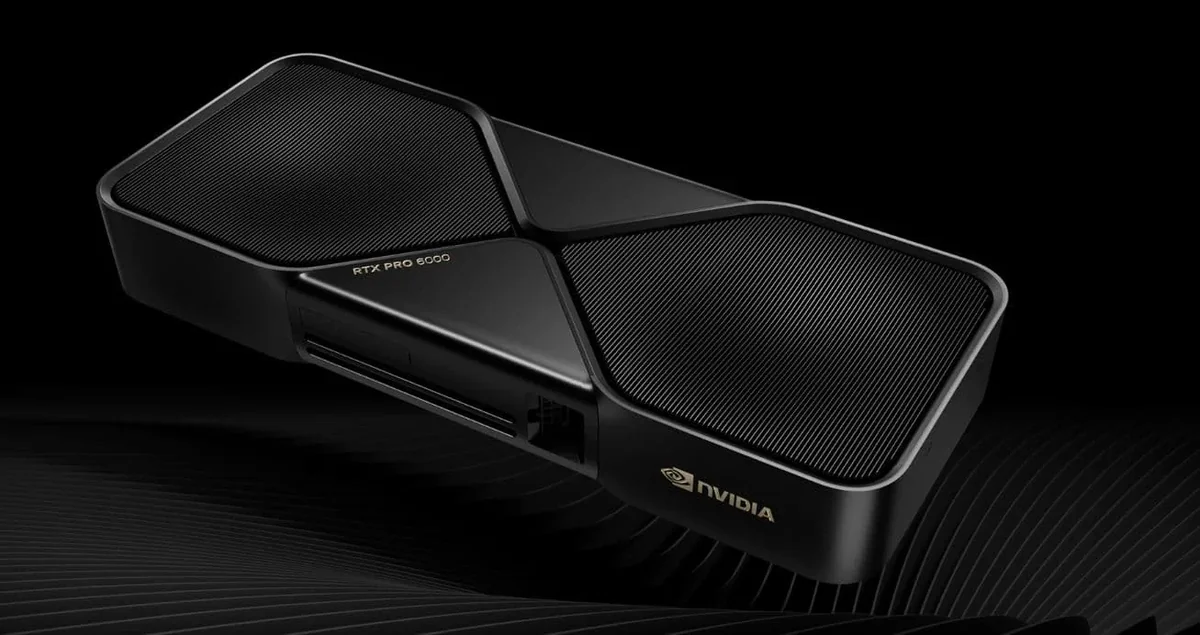
Imagine buying a graphics card that costs as much as a used car. NVIDIA’s RTX PRO 6000 Blackwell Workstation Edition has landed on the company’s marketplace with a sticker price of $13,250 — a jump that has turned heads across studios, research labs and system integrators.
The jump, explained
When the Blackwell-based RTX PRO 6000 first shipped in March 2025, it carried a premium launch tag (around $8,565). But official listings now show Nvidia asking $13,250 for the standard Workstation Edition — roughly a 55% increase over that launch figure. Retailers aren’t uniform: PNY’s listing sits notably lower at $11,359.99, while Newegg’s third‑party or OEM entries fluctuate around $12,099.99 to as high as $14,999 for server/OEM units.
That variability matters. Some early preorders and street prices dipped below $8,000 in 2025–early 2026, meaning many buyers who waited have seen an unwelcome climb. Different SKUs add confusion too: the Max‑Q Workstation and server-oriented variants appear at different price points, and some vendor listings are OEM-only, aimed at integrators rather than retail customers.
Why the premium?
Two big forces are at work. First, memory scarcity. The RTX PRO 6000’s headline spec is its 96 GB of GDDR7 ECC VRAM — record capacity for a workstation card — and high-speed graphics memory has been tight worldwide. That same squeeze has lifted prices elsewhere in computing hardware; you may recall a recent wave of RAM-driven price increases that hit laptops and desktops hard. Surface PCs get slammed with hefty price hikes as RAM crunch deepens.
Second, demand for large, local GPU capacity is surging thanks to AI. Teams training and fine‑tuning models, studios rendering dense VFX scenes or working with huge volumes and textures need both memory and compute. That makes a 96 GB card especially attractive, even at premium pricing.
Who needs 96 GB?
This card isn’t aimed at gamers. It’s built for complex professional workloads: dense VDB volumes in film renders, massive 3D scenes, digital twins, and local training or inference on medium‑sized models. The Blackwell GPU powering the PRO 6000 boasts 24,064 CUDA cores, fourth‑gen RT Cores and fifth‑gen Tensor Cores — specs that read like a data‑center part shoehorned into a workstation envelope.
For teams that hit VRAM limits, the alternative is awkward: split scenes, rely on out‑of‑core tricks that slow throughput, or move to cloud instances where costs and contention can be unpredictable. That’s why some vendors and service providers are packaging the cards into dedicated infrastructure: 1Legion, for example, offers nodes with eight RTX PRO 6000 Blackwell Max‑Q GPUs (768 GB total GPU RAM) to give studios predictable performance and billing for render or transcoding jobs.
Alternatives and cost tradeoffs
Not everyone will buy one of these cards outright. Options include renting bare‑metal nodes, using cloud GPUs, or even creative hardware workarounds — hobbyist and enterprise communities are experimenting with mods and older cards to run local LLMs more cheaply (a trend explored in discussions about a $200 V100 mod that makes local LLM hosting cheaper and messier). How an $200 V100 Mod Suddenly Makes Local LLMs Cheaper (and Messier).
PNY and other partners are positioning the PRO 6000 as the go‑to for workstation AI, emphasizing local training, real‑time multimedia workflows and enterprise manageability. That messaging resonates when you need guaranteed memory capacity and deterministic performance, but it comes at a cost.
What buyers should consider
Price volatility looks set to continue while memory supply tightens and AI demand stays high. If your workload truly requires 96 GB of GPU memory, the PRO 6000 may be the simplest path; if not, compare leased bare‑metal nodes, cloud instances, or multi‑GPU systems with partitioning until supply stabilizes. Also, check whether a retailer is listing an OEM board (often cheaper) and what warranty or support differences that implies.
NVIDIA’s $13,250 listing is more than a price tag — it’s a marker of where workstation GPU economics are headed: bigger memory, bigger demand, and a market that’s increasingly expensive to serve. For now, shoppers and labs will have to weigh performance needs against sticker shock — or find a way to rent it by the hour.