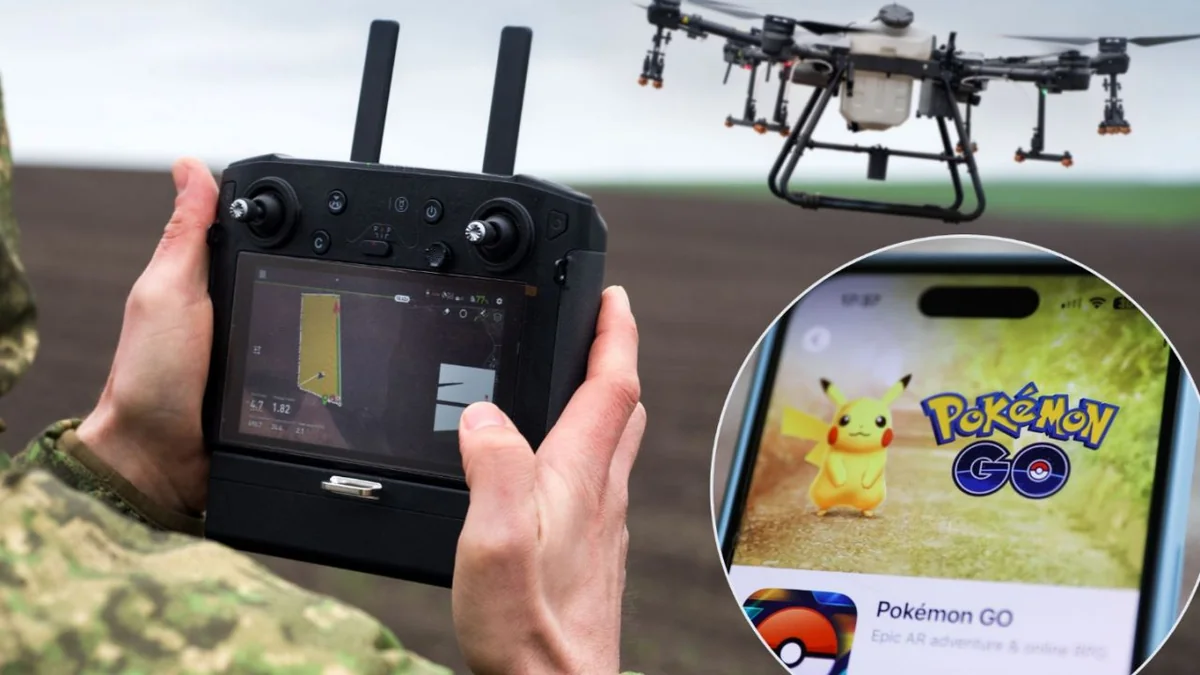
What if that quick AR scan you did for a Poké Ball reward quietly helped a drone find its way when GPS goes dark? That’s the concern swirling around recent reporting that links billions of voluntary Pokémon GO scans to the development of visual navigation systems now being eyed for aerial and ground vehicles.
The data and the deal
Players who used Pokémon GO’s AR scan feature uploaded short videos and 3D captures of public places—statues, fountains, plazas—over the years. Those scans were opt-in, rewarded in-game, and added up: outlets and reporting cite roughly 30 billion scans amassed while the game was at peak usage.
Those ground-level scans are owned by Niantic Spatial, the company that emerged from the original Pokémon GO maker after the game moved to a new owner. Last December Niantic Spatial announced a partnership with Vantor, a U.S. spatial-intelligence firm that works with defense and intelligence customers, to pair ground visuals with aerial data so systems can calculate locations even when GPS is jammed or unavailable. The pairing is exactly the kind of capability that matters in conflict zones, where satellites are unreliable and signals can be spoofed or blocked.
Niantic Spatial has pushed back on claims that Pokémon GO’s data is being handed to Vantor. In statements to reporters the company said Pokémon GO scans were used to train an early version of its real-world foundation models, but that those raw scans are not part of the current Vantor agreement. It also notes that after Pokémon GO moved to its new owner, Pokémon GO data is no longer shared with Niantic Spatial. Vantor, for its part, has denied using game data directly though it has not explicitly said whether the models it will deploy were influenced by earlier training that used AR scans.
That ambiguity is the problem: models trained on many contributors’ images become products of that training, not literal copies of the original uploads. Once a neural network learns from a trove of images, the resulting weights can help it navigate by recognizing places from only a few pixels—handy if a drone’s GPS is jammed.
How visual positioning systems change the rules
Visual Positioning Systems (VPS) use photographs or 3D reconstructions of environments to determine location and orientation. Unlike GPS, which depends on satellites, VPS looks at the scene itself—matching what a camera sees to a map of visual features. Combine detailed ground scans with aerial maps, and a system can lock onto a position from a fragment of a skyline or a single tree.
That makes VPS attractive for civilian uses—augmented reality, robotics, indoor navigation—but also for military or security applications where GPS denial is an operational reality. Critics worry that volunteer datasets collected for a game can accelerate development of systems used in surveillance or weaponized platforms.
Jeroen van den Hoven, an ethics and technology professor, told reporters that the sheer scale of scans from gamers likely sped up Niantic Spatial’s model development. “Without the huge number of scans from all those gamers, the development of this system would never have progressed so quickly,” he said, noting players may have indirectly contributed to military applications.
Consent, ownership and the fog of models
There are several moving parts to the controversy:
- Players opted in to AR scanning under terms of service in place at the time, and Niantic says those submissions were voluntary.
- Niantic Spatial says the models are the product of training and not direct copies of the scans. That’s technically accurate but doesn’t erase ethical questions about downstream uses.
- The Pokémon GO product and its data changed hands. Niantic Spatial contends that Pokémon GO data is no longer shared with it following the game’s move to its new owner.
For players and privacy advocates the details matter: did contributors truly understand how broadly models trained on their scans could be used? Once training influences a model, tracing a capability back to any specific dataset becomes difficult, which is why companies’ transparency about training sources and use restrictions is so important.
Concerns about large-scale image collection echo other recent debates over automated scanning and data harvesting—cases that have forced conversations about consent, oversight and the limits of “public” images. See how automated scans in other contexts raised alarms in the past with stories like LinkedIn’s BrowserGate, where background scanning sparked privacy concerns.
What companies say, and what they don’t
Niantic Spatial’s answers so far are layered: it acknowledges scans helped train early models, insists those scans were of public points of interest and says Pokémon GO data isn’t part of its current Vantor agreement. Vantor denies using Pokémon GO directly but has not fully detailed the lineage of the models it plans to deploy.
That leaves a gap between an engineer’s definition of a model’s “training data” and a public understanding of contribution and consent. As AI systems proliferate—open and closed models alike—the provenance and governance of training material becomes central. Industry advances such as open foundation models highlight why provenance matters; for more on the rapid expansion of such models see work on open systems like Gemma 4.
A patchwork of ethics and regulation
There is no single global rulebook that covers every dataset, every opt-in screen, or every downstream military use. Ethics statements, contractual limits and corporate policies all help, but they don’t replace transparent audits, meaningful consent, or regulatory guardrails that require higher scrutiny when civilian-sourced data could enable harmful outcomes.
For players who scanned a favorite plaza or a local monument: you did what the app asked and got a digital reward. What you might not have signed up for—and what companies and regulators are now debating—is whether that same data should accelerate systems that could be used on battlefields.
This story is still evolving. Companies have issued denials and clarifications, and reporters are digging into contracts and model provenance. The mix of gaming, AI, and defense raises questions that go beyond one app: about how the datasets we create for fun or convenience get folded into technologies with very different ends.