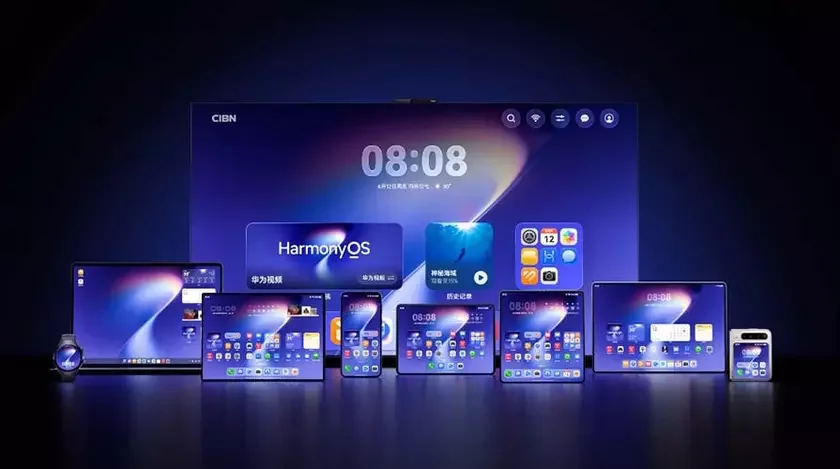
Imagine an operating system that can live in less memory than a low-res icon. That was the headline note at Huawei’s HDC 2026: HarmonyOS 7 brings a glossy new UI and deeper AI, and company leaders say the platform is already running stably on devices with just 128 KB of RAM—and could be pared down to 64 KB with further optimizations. They even suggested some HarmonyOS-powered devices can run for up to a year on a single dry cell battery.
Those claims are striking not because Huawei is chasing a spec for its own sake, but because they underline a longer strategy. HarmonyOS is not just a phone OS anymore; it’s the glue Huawei wants across phones, wearables, smart home goods, cars and industrial sensors. Small memory footprints and low power use change the design calculus for always-on sensors and tiny embedded controllers.
What Huawei announced (and what’s in the update)
At the conference Huawei showcased HarmonyOS 7’s visual refresh—what some called a “Liquid Glass” finish on the UI—and an upgraded on-device assistant built around an Intelligent Agent Framework 2.0. The company touted a roughly 15% performance uplift over HarmonyOS 6.1, new AI photo-editing tools, and an assistant that tries to complete more multi-step tasks (Huawei quoted a task-execution metric of "more than 90%," a number that invites a few follow-up questions about test conditions).
If the new look sounds familiar, that’s because modern OSes share aesthetic DNA—Apple’s Liquid Glass-era refinements were referenced repeatedly in the coverage. For more on how that design language is evolving elsewhere, see how iOS has softened its Liquid Glass elements recently iOS 26.4 softens Liquid Glass, adds emoji and music tweaks — macOS gets battery smarts.
The developer beta arrived right after the keynote, with a wider rollout promised later in the year.
The 64 KB claim: impressive, but read the fine print
Saying HarmonyOS can run on 64 KB of RAM is a headline-grabber. But there are important qualifiers:
- Huawei’s executives framed the number in the context of tiny IoT endpoints—sensors, simple wearables and smart-home peripherals—where a minimal runtime and energy thrift matter more than full smartphone functionality.
- “Running stably” doesn’t mean a full Android-like experience; it likely refers to a stripped runtime or a microkernel-mode component tailored for MCUs (microcontroller units) rather than the heavy app stack on phones.
- By contrast, even stripped-down Android builds today assume megabytes to gigabytes of memory, so the comparison highlights a strategic difference rather than a direct technical apples-to-apples.
For historical perspective: early desktop systems used megabytes (Windows 95 needed around 4 MB), so tiny footprints aren’t new—but bringing modern connectivity, security and some AI into that envelope is nontrivial.
Why this matters beyond bragging rights
If HarmonyOS truly scales down to tiny controllers while sharing tooling and a developer ecosystem with larger devices, Huawei can sell the same platform across an enormous product range—sensors that sip power for a year on a single battery, smart plugs, wearables and car dashboards that interoperate more easily.
That’s exactly the use case Huawei is chasing. The company says HarmonyOS now spans more than 1.3 billion active connected devices across phones, PCs, appliances and automotive systems, and tens of thousands of native apps. Those numbers show reach inside China and certain partner markets, even if the OS remains largely absent from Western retail channels.
The geopolitical and business context
HarmonyOS’s growth is inseparable from the sanctions that pushed Huawei off Google’s stack. Building an independent platform has advantages—control over services, deeper vertical integration and fewer third-party dependencies. But it also creates limits: no Google Play in Europe and India, and little retail presence in the US and UK.
That single-vendor model concentrates risk. Other Chinese OEMs largely avoid HarmonyOS because adopting it can jeopardize their access to Western services. So while Huawei can scale big inside its own ecosystem, global expansion faces political, regulatory and partner hurdles.
AI, agents and realism
Huawei’s Intelligent Agent Framework 2.0 and the assistant’s broader in‑app command support are part of the industry’s wider push toward “agentic” AI: assistants that do multi-step tasks for you. It’s a crowded space—the wider OS and device players are also reworking assistants and standalone apps to let AI act on your behalf—and that competition will shape user expectations quickly. (If you’re tracking where voice and assistant architectures are headed, Apple’s own moves around a dedicated Siri app and business-focused AI tooling are worth watching.) Apple to Ship a Standalone Siri App and New Business Hub — and Let You Pick Which AI Answers
Huawei’s claimed task-execution rates and performance gains are promising but not yet independently verified across real-world scenarios. Benchmarks and real-world tests (battery life under continuous connectivity, multi-device handoffs, security under constrained hardware) will matter more than keynote metrics.
A cautious applause
There’s nothing wrong with ambition. HarmonyOS 7 stitches together design flourishes, tighter performance, and an AI-forward narrative while pushing the platform into tiny, power-constrained hardware. If Huawei can genuinely deliver a secure, low‑memory runtime that integrates with phones and cloud services, it could ease the work of product teams building smart-home and industrial devices.
At the same time, claims about 64 KB and year-long single-cell life deserve independent scrutiny and clear definitions: which features are included, what networking and security stacks run in that footprint, and how durable those gains are at scale. Until reviewers and third-party developers get their hands on a broad set of devices, the announcement is an intriguing technical signal rather than proof of a paradigm shift.
Huawei has built momentum—1.3 billion devices is a headline number—but converting that into a globally competitive, open ecosystem without the usual Android partners remains the company’s core challenge.