Ask Siri a practical question — “add these events from my email to my calendar” — and until now you’d have been more likely to sigh than celebrate. At WWDC 2026 Apple showed the version of Siri it has been promising for years: conversational, screen‑aware, able to act on what’s visible, and — crucially — actually useful in simple everyday tasks.
A Siri that does small things well
Early hands‑on reports suggest the new Siri AI doesn’t try to be everything at once. It will parse an email or a screenshot, add multiple events to your calendar, parse a rental‑return date, diagnose a wilting plant from a photo and even build a checklist for a backyard project — all from single prompts. That modesty is part of the win: these are the mundane, frictiony chores people actually want an assistant to handle, and Apple’s first priority appears to have been reliability over flash.
The personality is more direct than some rivals. Where other assistants might preface suggestions with long empathy lines, Siri usually gets to the point and then waits for follow‑ups. It’s conversational but restrained, which many users will prefer for quick tasks. The assistant surfaces in more places across Apple platforms: a Dynamic Island indicator on compatible iPhones, a dedicated Siri chatbot app, integration into Spotlight and screenshots on Mac, and more. Not everything arrives at once globally — the EU rollout is limited at launch — but the footprint is broad.
How Apple says it keeps your stuff private
Apple’s pitch has always been privacy‑first, and the company leaned on that messaging while explaining how Siri taps personal context. On‑device indexing collects signals from email, messages and calendar items so the assistant can reference them without sending whole inboxes to the cloud. Prompts that cannot be completed locally are routed to Apple’s Private Cloud Compute with only the necessary slices of personal data attached — not a blunt dump of your account.
That hybrid approach is meant to strike a balance: meaningful context for better answers while limiting exposure of private data. It’s a different tradeoff than some competitors, which ask you to explicitly link accounts or pull data directly from Gmail and Calendar. Apple’s system hides most of that complexity from users while offering controls and limits.
Not everything runs on Apple silicon
Behind the scenes there’s an important caveat: Apple is not keeping all heavy lifting on its own chips. The company’s new frontier model — dubbed FM Cloud Pro — is intended for the most agentic, multi‑step reasoning tasks, and those workloads are being run on Nvidia GPUs hosted in Google Cloud. That decision marks a shift away from Apple’s long‑running experiment with an M‑series private cloud; the firm concluded those in‑house systems couldn’t comfortably scale the most demanding workflows.
Apple’s private cloud and on‑device engines still do a lot of the work, especially for local model inference and routine Apple Intelligence features. But for frontier agentic reasoning — the kind of multi‑step, compute‑heavy tasks that power complex planning and orchestration — Apple is leveraging hyperscaler GPUs. The practical upshot: users get more capable AI, but the architecture is mixed rather than purely vertical.
Tools for developers and where Siri plugs in
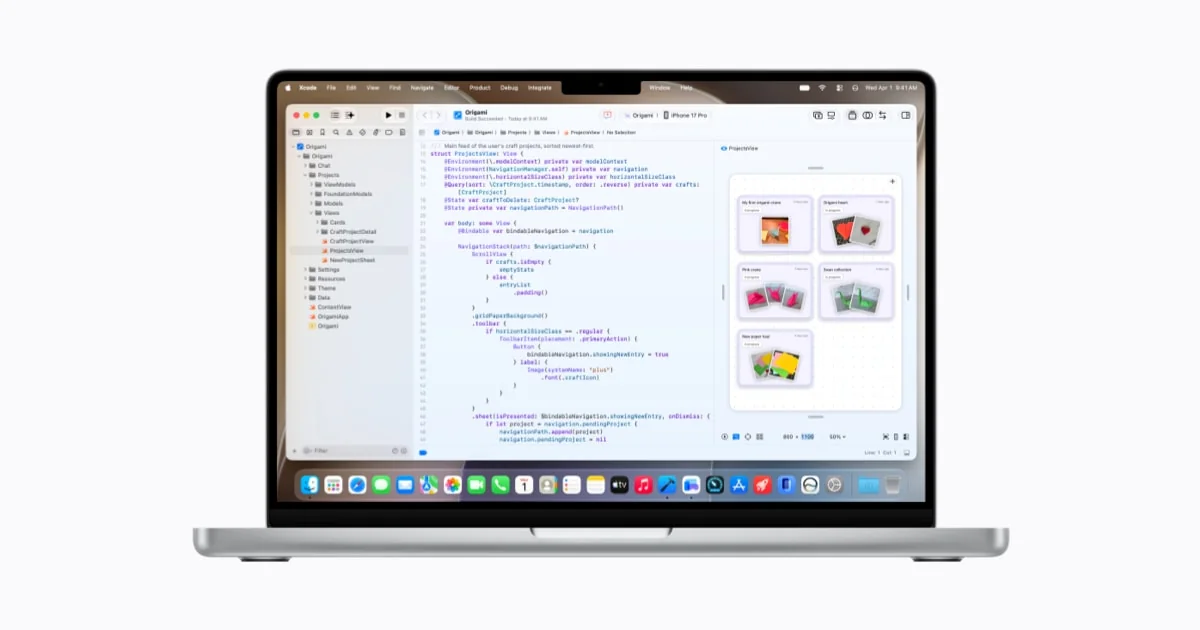
Apple didn’t treat Siri AI like a standalone novelty. It folded the assistant into a broader developer story: updated intelligence frameworks, a single Foundation Models API for Swift, and a new Core AI runtime for on‑device models. Xcode 27 now includes agentic coding features so developers can use models and coding agents inside the IDE — writing, testing and even running previews with model assistance.
Apple’s press release lays out these changes in detail and explains how developers can plug into the system, use server models, or run models on device: Apple newsroom: Apple accelerates app development with new intelligence frameworks and advanced tools. For app makers this is significant: you can wire app actions and on‑screen awareness into Siri AI and ship experiences that feel native rather than bolted on.
If you’re curious how the system shapes the rest of the OS, Apple’s refreshes to system design and search — including changes to Liquid Glass and a rework of Spotlight and Safari — are meant to make intelligence feel integrated, not intrusive. For more on the interface and macOS tweaks, see the macOS 27 notes on Liquid Glass and Safari AI features macOS 27 will tune Liquid Glass and give Safari an AI tidy‑up.
A pragmatic, not headline‑grabbing launch
This isn’t the kind of AI debut that blows minds with artful hallucinations or cinematic demos. It’s pragmatic: focused on chores, calendar parsing, photo understanding and contextual replies. That matters. Apple needed a version of Siri that simply works, and the first impressions suggest it does. For enterprise and developers, the mixed compute strategy — on‑device, private cloud and hyperscaler GPUs for frontier models — signals realism: Apple is choosing performance and scalability where necessary.
There are tradeoffs. Regional availability will lag in some markets, and a hybrid cloud approach invites scrutiny from privacy purists. But the combination of tighter on‑device context handling, Private Cloud Compute for limited slices of data, and the ability to plug third‑party models into apps gives Apple a pragmatic path forward.
Siri AI’s arrival is less fireworks and more plumbing: quietly useful, built to slide into people’s existing workflows, and anchored to a developer platform that wants to make agentic features a normal part of app development. If you use an iPhone 16 or a recent Mac, you’ll probably notice it more in day‑to‑day tasks than you will in headlines — and for a system that once struggled to do simple things reliably, that’s a meaningful change. For more on how Apple plans to let developers extend Siri and choose which models answers come from, see the related developer preview and notes on the standalone Siri app Apple to Ship a Standalone Siri App and New Business Hub — and Let You Pick Which AI Answers.