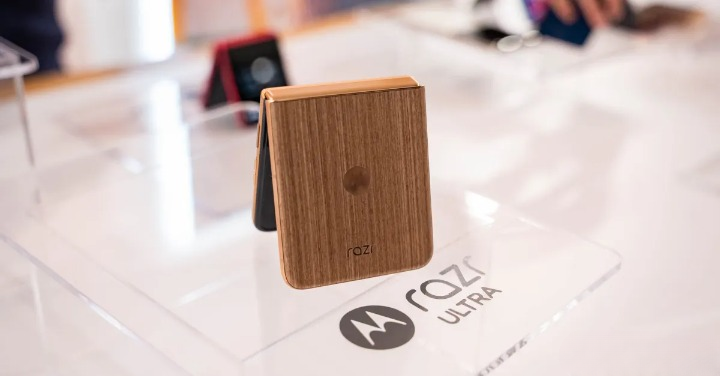
A steady drip of renders and spec lists has left Motorola’s next clamshell foldable feeling…unambitious. The Razr 70 Ultra that keeps showing up in leaks looks like a careful iteration rather than a reinvention: a bigger battery, the same flagship chipset as last year, and a familiar camera stack.
What the leaks say
Two outlets independently published the same spec set this week, and the details line up neatly. The Razr 70 Ultra is said to open to a 7‑inch inner display with a 1224 x 2992 resolution and keep a large 4‑inch cover screen at 1080 x 1272. Unfolded dimensions come in at 171.48 x 73.99 x 7.19 mm and weight at 199 g — essentially unchanged from the previous model.
Under the hood the phone reportedly runs Qualcomm’s Snapdragon 8 Elite (the same chip Motorola used in last year’s Razr Ultra), paired with 16 GB of RAM and 512 GB of storage. The battery is the headline tweak: 5,000 mAh, up from 4,700 mAh (roughly a 6% increase). Motorola’s rumored charging spec is 68 W wired, and the phone is expected to boot Android 16. Camera hardware, according to the leaks, stays with three 50 MP modules — main, ultrawide, and a 50 MP selfie unit — while the body carries an IP48 ingress rating.
Those numbers first circulated in a GSMArena report and were echoed in coverage across tech sites. 9to5Google’s write-up highlighted the oddity that Motorola might keep the same Elite chip in a handset the company positions as a top‑tier foldable.
Why that matters (and why it might not)
A chipset holdover on a flagship raises eyebrows because the mobile market expects annual silicon refreshes. If a phone that’s supposed to be Motorola’s best doesn’t get a generational upgrade, buyers naturally ask why — and whether the company is leaning on other strengths instead (design, screens, cameras, or price).
There are a few reasonable explanations. Supply and pricing pressures can steer makers toward reuse: reusing a proven SoC saves validation time, reduces engineering risk, and can let a company price more aggressively. Thermal management and battery life trade‑offs also matter for clamshell foldables, where surface area and hinge designs constrain cooling. A slightly larger cell — the 5,000 mAh bump — could be Motorola’s priority this cycle, aiming for better real‑world endurance rather than raw benchmark speed.
That strategy isn’t necessarily reckless. Motorola’s foldable catalog has lately leaned into design and display tricks that reviewers find compelling; the company’s newer fold models have drawn praise for build and camera quality, which suggests Motorola believes it can compete on experience rather than chasing headline silicon. If you’re interested in how Motorola’s foldable design direction is playing out in larger formats, our hands‑on impressions of the Razr Fold are worth a read The Motorola Razr Fold Is So Good, It Has Me Rethinking the Galaxy Z Fold 7.
The battery and charging picture
A 5,000 mAh cell in a clamshell is notable. Foldables have struggled with battery life because of big bright panels and power-hungry silicon; any increase helps. The leaked 68 W wired charging figure is solid but not class‑leading — Motorola’s larger Razr Fold showed faster 80 W wired capabilities in recent demos — so Moto appears to be balancing capacity and charging speed rather than pushing for the absolute fastest charge.
Cameras, screens and durability: steady as she goes
Keeping three 50 MP sensors suggests Motorola thinks its imaging pipeline — optics plus software — remains competitive. The dual‑display configuration with a roomy 4‑inch cover screen is still one of the more practical implementations of an outer display on a flip phone; it lets you do more without opening the device.
IP48 is a pragmatic water/debris rating for a foldable, on par with what other makers are offering in the segment. It won’t make your phone invincible, but it helps reduce worry around everyday spills and dust.
What we don’t know (yet)
Leaks give dimensions and parts, but they don’t tell us pricing, final software polish, or how Motorola will position the Razr 70 Ultra against its own Razr Fold and rivals from Samsung and Google. Nor do they confirm performance under sustained load or the kind of camera processing that can make 50 MP sensors sing.
If you’re tracking chip choices and flagship comparisons, the wider market context matters — recent flagship reviews and roundups show how much weight consumers still put on silicon and imaging, and how that trade‑off affects value and recommendation decisions Samsung Galaxy S26 Ultra: Safe Upgrade, Smart Privacy, Spotty Hype.
Reading the signs
Taken together, these leaks sketch a phone that’s evolutionary not revolutionary. For buyers who prioritize battery life, a large cover screen, and Motorola’s current foldable design language, the Razr 70 Ultra could be an attractive pick. If you buy into the idea that every new flagship must have the newest chip, this model might disappoint.
Leaks are only one chapter of the story. Motorola still has room to surprise us with pricing, software features, or final hardware tweaks before launch. For now, the Razr 70 Ultra looks like a confident, careful step forward — not a leap.