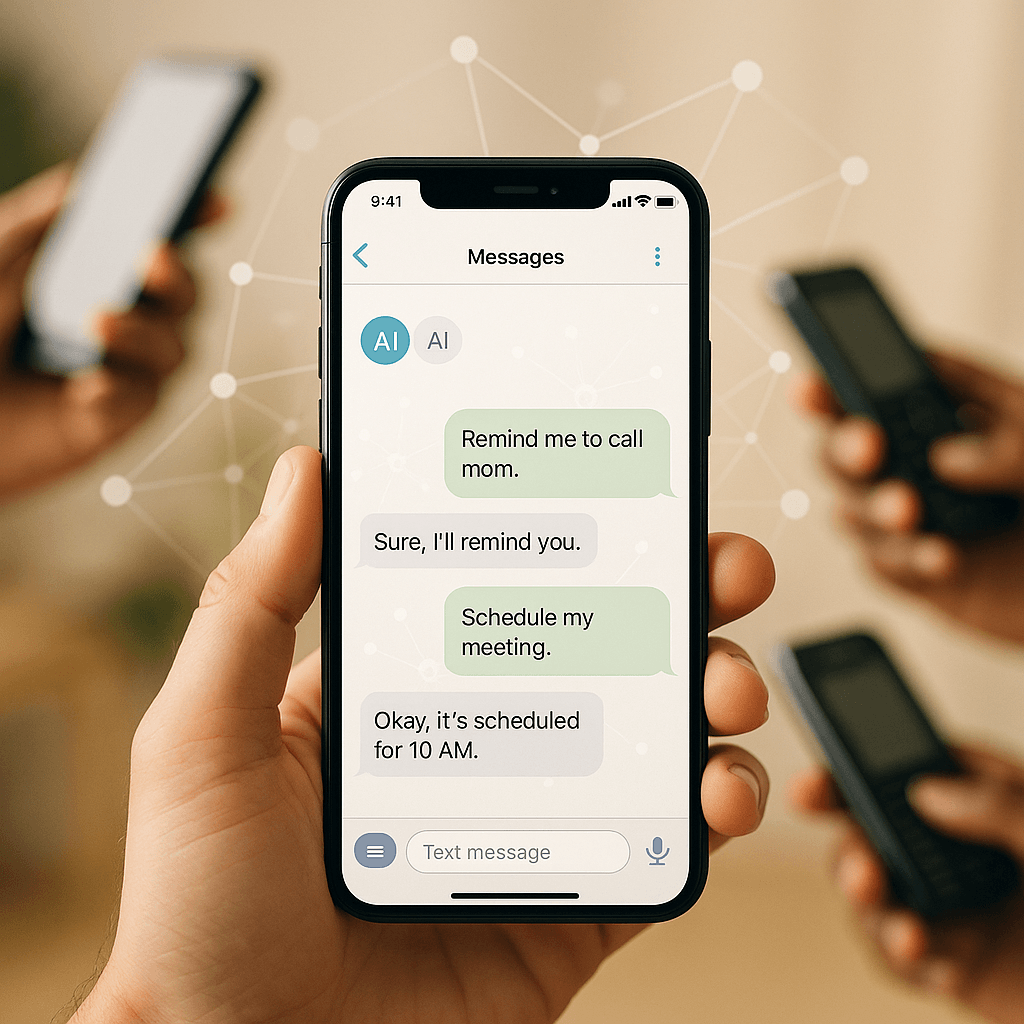
Imagine automating your day with the same handful of words you use to check in with a friend. That’s the bet behind Poke, a tiny Palo Alto startup that launched a text-first AI agent in March and wants to make automation feel as ordinary as sending “on my way.”
Poke isn’t trying to out-chat ChatGPT. Instead it focuses on doing: scheduling, email monitoring, medication reminders, smart‑home controls, fitness tracking and other chores — all over iMessage, SMS, Telegram and, in select markets, WhatsApp. There’s no app to install. You go to Poke.com, type your phone number, and start texting.
Why text?
The company’s origins help explain the choice. Poke grew out of an email assistant experiment; beta users kept asking that assistant to do non‑email things — tell them the morning weather, nudge them about meds, summarize a game score. The founders leaned into that impulse. Text messaging is universal, low friction, and familiar even to people who don’t want to wrestle with new apps or developer tools.
That simplicity is the product’s sharp edge. While enterprise and power‑user agent frameworks require installs, terminal commands or deep system access (and raise obvious security worries), Poke aims to hide the plumbing behind plain language “recipes” you can click to set up. It’s a classic consumer play: make the hard stuff invisible and users will bring the use cases.
What it actually does
- Activates prebuilt automations called “recipes” — from calendar helpers to Strava syncs and Philips Hue controls.
- Connects to common services (Gmail, Google Calendar, Outlook, Notion, Linear) and developer tools (GitHub, Vercel, Supabase) for power users.
- Lets users author and share automations in plain text; creators earn small referral payouts when recipes attract new signups.
- Runs on messaging via a Linq integration so it can live inside iMessage and other chat clients without a native app.
Under the hood, Poke picks the AI model that fits each job — a mix of big‑provider and open‑source models — rather than locking itself to a single vendor. That flexibility is pitched as a competitive advantage in a world where many players are married to their own stacks. (If you’re following the agent arms race, this echoes broader shifts — some new open models are explicitly built for agentic use cases, and platforms are racing to be the engine under the hood.) See how open agent models are shaping the landscape in our coverage of Gemma 4.
Funding, scale and the plan
Poke’s 10‑person team recently added $10 million on top of a prior $15 million seed, valuing the company at roughly $300 million post‑money. Investors include Spark Capital, General Catalyst and a long list of high‑profile angels: the Collison brothers, builders from Vercel and Hugging Face, and others who’ve been active in the agent space.
Growth is the stated priority. The company says signups have accelerated — a 10x jump in recent months — and it’s experimenting with viral hooks: creators can publish recipes and earn small bounties when those recipes bring new users in.
Pricing, privacy and limits
Poke is free to start. The company’s pricing logic is usage‑based: tasks that don’t require continuous, real‑time inference are likely free; workflows that demand ongoing checks (e.g., monitoring every incoming email or live flight status) incur costs. During beta the product even experimented with letting users negotiate price with the agent — a quirky aside that speaks to how granular their cost model can be.
On privacy and security, the startup points to layered defenses: penetration testing, restricted employee access, and a model where token contents aren’t visible to the team unless users explicitly opt in. Those controls help, but independent audits and real‑world testing will matter if Poke wants mainstream trust.
There are platform constraints too. WhatsApp has been difficult terrain — Meta’s third‑party chatbot restrictions and high fees have limited access, though regulatory pushback in regions like the EU and Brazil may open doors over time. On iOS, Poke’s SMS/iMessage approach also slots into a broader conversation about where assistants live on phones — a discussion Apple itself is pushing with ideas like a standalone Siri app and letting users pick which AI answers them (Apple to Ship a Standalone Siri App).
Why it might matter — and where it could stumble
Poke’s clearest strength is accessibility. If agentic AI is going to reach ordinary people, lowering the friction to a single phone number is a smart move. SMS works on feature phones and in places where app ecosystems are fragmented; that opens potential global reach.
The challenges are practical and regulatory. Deep automation requires secure credentials and dependable integrations; doing that over text without a traditional app surface is clever but complex. Monetization is also unresolved: the company says growth beats immediate profit, but long‑term economics for always‑on agents (and the cloud costs of real‑time inference) are nontrivial. Finally, platform gatekeepers can change rules or pricing overnight.
Poke’s play is a reminder that the AI race is as much about interfaces as it is about models. You can have the smartest agent in the world, but if people can’t use it without fiddling, adoption stalls. Whether Poke’s SMS trick becomes a mass‑market route or a clever niche depends on how well it balances usefulness, cost and safety.
If it works, your messages could quietly become the center of a new kind of personal operating system — one that runs on plain language, small permissions and a phone number you already know.