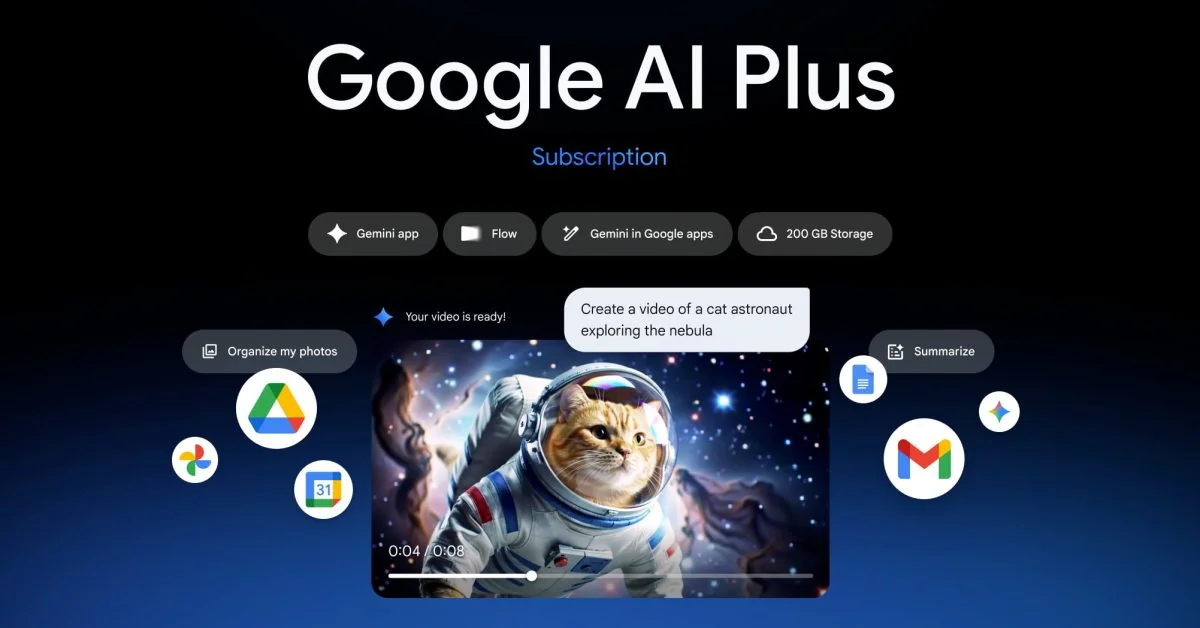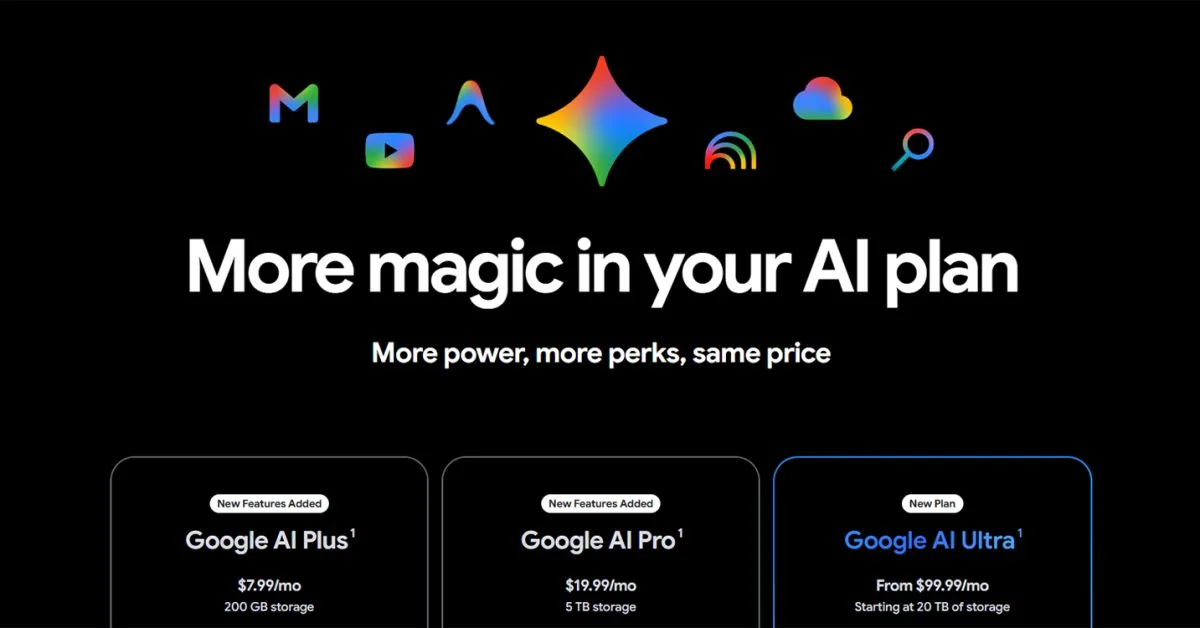
Google just made a move that looks small on the receipt and large on the chessboard. The company cut the price of its consumer AI subscription, Google AI Plus, from $7.99 to $4.99 per month and doubled the included cloud storage from 200GB to 400GB. The change landed quietly—Vikas Kansal, the product lead for Gemini subscriptions, posted the update on X—and it’ll roll out to users over the next several days.
What this actually gives you
At $4.99 monthly, AI Plus now includes 400GB shared across Gmail, Drive and Photos, alongside upgraded Gemini usage limits (roughly 2x for many users) and access to features beyond the free Gemini tier: Omni Flash video generation, creative tools like Google Flow, and NotebookLM (Google’s research assistant). Google still sells higher tiers—AI Pro and AI Ultra—with bigger limits and additional perks for power users.
A quick consumer lens: the math changes. Middle-ground storage tiers were oddly absent in prior plans; getting 400GB for five bucks is close to unheard-of among big cloud providers. For some buyers, that storage bundle—plus extras—will be the real lure, not just the chat features.
This is a price war, not a charity act
The cut reads less like a promotional stunt and more like a strategic salvo. Executives and investors watching the AI stack say we’re moving into commoditization: raw model access and compute could soon be perceived as interchangeable, and companies with broad ecosystems and distribution—Google chief among them—can squeeze margins by bundling and undercutting specialized players.
Chi‑Hua Chien, a consumer-focused investor quoted in coverage of the move, pointed out the historic pattern: infrastructure companies that power eras often see margins erode as services get commoditized and buyers chase price over provenance. If foundation models follow that arc, independent model providers and infrastructure-focused startups will face increasing pressure.
The price play has precedent. Companies experimented with localized, low-priced tiers in fast-growth markets like India—OpenAI’s ChatGPT Go and Google’s earlier local AI Plus pricing are examples—and now that logic appears exported to the U.S. That matters because moves that begin as emerging-market experiments can shape global pricing psychology: once low-cost expectations form, they’re sticky.
Why competitors should care
Anthropic has not mirrored Google’s low-cost U.S. tiering. OpenAI and Anthropic’s public-market ambitions could meet a tougher reality if buyers expect cheaper access or if bundlers like Google keep leveraging non-AI perks to make subscriptions feel like a bargain.
Put another way: valuation multiples and revenue-per-user assumptions that underwrote recent funding rounds may be tested if the midmarket starts migrating to $5-a-month bundles.
Bundles change the conversation
Google’s advantage isn’t only its models; it’s the rest of its stack. The company has quietly rebranded many Google One storage plans as AI plans, folding in perks that make higher tiers feel like deals—YouTube Premium Lite, Google Home Premium and health features have been bundled into AI Pro, for instance. For many users that means perceived value well above the sticker price.
Writers who follow subscriptions closely argue this is why some Google plans suddenly look like the best consumer tech deal around: you’re paying for storage and getting upgraded AI access as a bonus. If you want to see how Google is tying NotebookLM into everyday workflows, the new Gemini Notebooks offer a glimpse of that integration Gemini’s new Notebooks bring NotebookLM into your chats. And the company’s push to weave Gemini across Android and devices helps turn the subscription from an optional add-on into something you keep using daily Google pushes Gemini deep into Android with proactive AI.
A few wrinkles to watch
- Power users may still prefer dedicated, higher‑quota tiers or specialist AI subscriptions if they need heavy model access or specific safety/privacy commitments.
- Privacy-conscious users will ask whether more storage means more data available to train models; Google maintains policy and controls, but perception matters.
- Startups that sell model access will feel margin pressure; some may pivot to verticalized apps where differentiation is stickier.
Google’s cut is simple at the surface: cheaper plan, more storage. Underneath, it’s a test of whether bundling and distribution can mute the premium that pure-play AI vendors have been able to charge. For consumers hunting the best bang for five bucks, it already looks attractive. For the rest of the industry, it’s an invitation to rethink pricing and product strategy—fast.